


Market Demand Growth Analysis Report for Self-Fill Football Turf Systems
Market Demand Growth Analysis Report for Self-Fill Football Turf Systems
 Report Type: Regional Market Research | Date of Issue: August 28,2026
Data scope: Based on multiple industry research reports and domestic industrial surveys for the period 2025–2026 (source details provided at the end of the document).
I. Conclusion Summary
Non-filled football turf (sand-free or granular artificial turf) is currently experiencing an accelerated phase of replacing traditional filled turf worldwide. Listed in order of growth rate for the "non-filled turf" segment:
Europe ≈ Middle East (GCC)> Asia-Pacific> Latin America> North America
Europe: The strongest policy driver with the highest certainty (EU to implement a comprehensive ban on polymer-filled particles by 2031);
Middle East (GCC Gulf States): Environmental adaptability – a fundamental demand combined with a low base – drives the strongest growth rate;
Asia-Pacific: Infrastructure-driven growth with the largest scale potential (Southern China, India, and ASEAN);
North America: The market is large but has a slow growth trajectory, with a greater preference for the organic filling approach.
II. Market Background
2.1 Overall Market
The global artificial turf market is projected to be valued at approximately US$6.54–6.85 billion in 2025 and is expected to reach around US$12 billion by 2032, representing a compound annual growth rate (CAGR) of approximately 7.2%–9.0%.
The "Eco-Friendly Lawns" segment (recyclable / refill-free / bio-based) is projected to reach approximately US$1.47 billion in 2025 and is expected to grow to US$3.21 billion by 2032, representing a CAGR of 11.85% – significantly outperforming the overall industry average.
Artificial turf for football fields – Regional market share (2025): Europe – 38.3%; Asia-Pacific – 25.7%; North America – 23.9%; Middle East and Africa – 7.1%; Latin America – 5.0%.
2.2 Why acceleration with no filling
Policy-driven pressure: The EU ECHA Microplastics Restriction Regulation prohibits the sale of polymer filler particles (including rubber particles, TPE, EPDM, etc.) used in synthetic sports surfaces effective October 2031, with an eight-year transition period; ECHA estimates that artificial turf releases approximately 16,000 tons of microplastics into the EU environment annually.
Environmental and safety considerations: Filled grass products pose challenges such as particle scattering, high-temperature clumping, unpleasant odors, and safety hazards for children during physical activities; additionally, they entail high maintenance costs.
Technical maturity: The fill-free system, represented by the High Weight Curved Thread (KDK Process), has been FIFA certified; its performance characteristics (ball rolling, impact absorption, and rebound) comply with international standards.
III. Regional Demand Growth Analysis
3.1 European Union (EU) – The strongest policy-driven certainty
The European Union is the world's largest market for artificial football pitches (accounting for 38.3% of the global market in 2025, or approximately US$1.34 billion), benefiting from a large existing base of installed pitches.
With the microplastic ban coupled by an eight-year transition period, both new construction and renovation projects are increasingly shifting toward refill-free systems or organic fillers (such as cork, coconut shells, or olive pits), making the demand for alternative solutions particularly robust.
Entry requirements: FIFA Quality Certification, EN 15330 Standard, and Recyclability & Environmental Certification have become mandatory procurement criteria.
Notable developments: The world's first recyclable, fill-free football field, which has obtained the relevant international certification, has been installed in Tianjin and has attracted inspection visits from multiple countries; the European Community project has secured bulk repeat purchases thanks to its green policy initiatives.
3.2 Middle East (GCC Gulf States) – The dark horse driven by environmental adaptability
Extreme heat combined with severe water scarcity – natural grass cannot thrive under these conditions; the refill-free system eliminates granular splashing, eliminates the need for frequent maintenance, and consumes almost no water – precisely addressing these critical challenges.
The governments of Saudi Arabia, the United Arab Emirates, and Qatar have made substantial investments in sports infrastructure (World Cup legacy venues, school sports programs, and projects aligned with the 2030 Vision); therefore, school-based sports environments impose extremely stringent environmental and safety requirements.
This region has a relatively small market size (approximately 5%–7%), making it a typical low-base, high-growth market with the most significant percentage growth rate.
3.3 Asia-Pacific – Infrastructure Expansion Growth
The Asia-Pacific region is widely recognized as the fastest-growing market for artificial turf (with a CAGR of approximately over 7.5%, exceeding the global average), driven primarily by school and community sports investment in China, India, and ASEAN.
There is a significant north–south divergence within China:
The southern market leads the northern market by 5–6 years; over 70% of existing site renovations involve clients proactively requesting exemption from backfilling;
The northern market has been hindered by negative perceptions surrounding early-stage, low-quality unfilled products (such as uneven surfaces, cracking, or bulging), resulting in a slow pace of renovation adoption; therefore, the use of demonstration samples and market education is necessary.
Guangdong and Jiangsu have established artificial turf industry clusters with low supply chain costs, which in turn has accelerated their market penetration in southern China.
3.4 North America – Large market size, but slow growth momentum
In North America, the market accounted for approximately 24%–35% of the global market in 2025, driven primarily by facility renovation cycles as well as university and municipal procurement activities.
The focus is increasingly shifting toward organic alternatives: Colorado implemented a PFAS ban effective January 2026; California announced health study findings covering 35 sites and over 100 chemical substances in January 2026.
The filling-free permeation rate is lower than that in Europe, representing a "gradual upgrade in mature markets."
3.5 Latin America – Follow-the-Leader Growth
Football academies and municipal sports facilities in Brazil and Mexico represent the primary demand drivers; however, their growth rate is moderate due to constraints imposed by purchasing power and installation quality.
Regional Comparison Summary Table
area | 2025 Market Share | Zero-Fill Growth Rate Assessment | Core Driver | Primary threshold |
Europe(EU) | 38.3% | ★★★★★highest | 2031: Microplastic Ban & Renovation & Upgrading | FIFA Certification, Environmental Recycling Requirements |
Middle East & Africa (GCC) | 7.1% | ★★★★★ High (low base) | Water scarcity and high temperatures; government sports investment | Certification and case studies, weather resistance |
Asia-Pacific | 25.7% | ★★★★☆ | Infrastructure expansion; school and community investment | Price sensitivity and low-price competition |
North America | 23.9% | ★★★☆☆ | Site Renovation Cycle | Slow response and complex regulatory environment |
Latin America | 5.0% | ★★★☆☆ | Football Academy, Municipal Sports Facilities | Purchasing power, installation quality |
IV. Summary of Core Driving Factors
Regulatory drive (Europe): The microplastic ban serves as the most direct "demand-driven catalyst" for the refill-free market, while the refurbished market continues to gain momentum during the transition period.
Environmental adaptation driver (Middle East): Water scarcity and high temperatures make refill-free solutions the only viable option; demand is strictly dictated by geographical conditions.
Infrastructure expansion driver (Asia-Pacific): Urbanization and investment in sports facilities have generated a significant number of new venues; the low-maintenance, no-backfilling advantage is now factored into long-term cost considerations.
Cognitive Repair Driver (Southern China): Existing property owners have a clear awareness of the pain points associated with grass filling and proactively specify no grass filling required; the northern region is currently undergoing a phase of negative cognitive repair and represents a potential source of future growth.
V. Supply-Side Key Considerations and Risk Warning
Process barrier: The core non-filling process utilizes KDK high-weight curved yarn, which requires specialized equipment and involves lower production efficiency (8–10 days per batch for 8,000 m² vs. 3 days for filled grass); consequently, the production cost is higher than that of traditional filled grass.
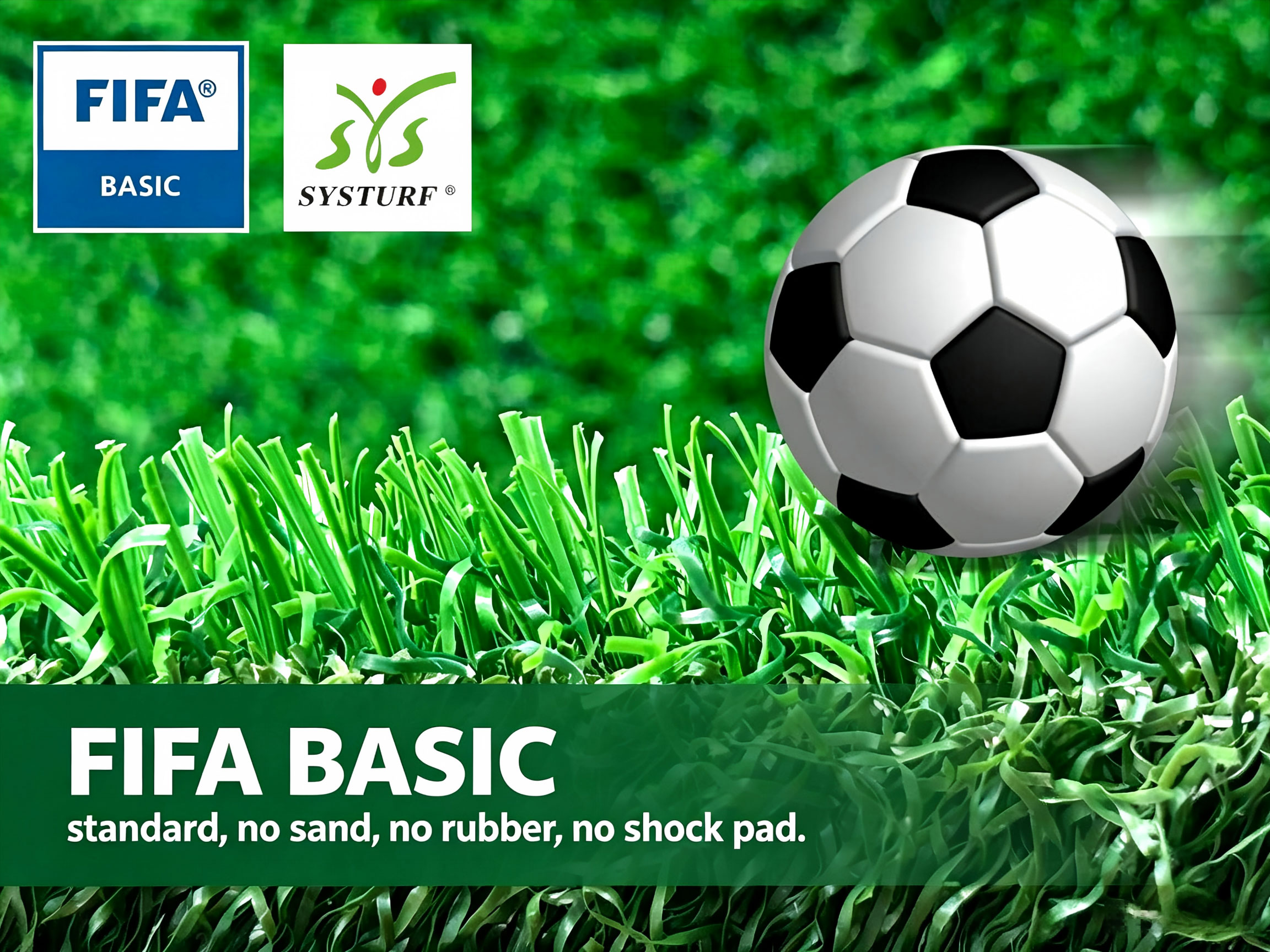
Certification barriers: International certifications (such as the FIFA Quality Programme) serve as the gateway to the European and GCC markets; currently, the dominant influence in this sector is concentrated among leading European and American manufacturers (e.g., Tencate). Domestic manufacturers, such as SYSTURF, have launched non-infill turf products since 2016, which have successfully passed FIFA laboratory performance tests, in 2024 SYSTURF’s new nonfill soccer system Basic-35Pro pass FIFA BASIC test(SYSTUF is Asia’s first artificial turf manufacturer achieving FIFA BASIC standards with no quartz sand, rubber infill or shockpad.), thus possess significant competitiveness.
Market challenge: Customers prefer an "soft touching" appearance, whereas high support performance requires thick, heavy yarns – creating an inherent conflict between aesthetics and performance that must be balanced through careful formulation.
Domestic strategy recommendations: In southern China, prioritize free-fill renovation projects; in northern China, use traditional fill grass as the core business base, while simultaneously developing pilot projects and conducting market education to achieve gradual market penetration.
VI. Data Sources and Notes
NetEase Industry Deep Dive Summary: "Current Status of the Artificial Turf Industry and Discussion on Non-Fill Artificial Turf Technology for Football Fields" (2026-07)
PW Consulting《Worldwide Sports Artificial Turf Market 2026》《Worldwide Artificial Football Lawn Market 2026》
360iResearch《Artificial Grass Market Global Forecast 2026–2032》
Emergen Research《Artificial Grass Market 2025–2035》
Pro Market Reports《Synthetic Sports Turf Market 2025–2033》
Note: The "Free-Fill Demand Growth Rate Assessment" in this report represents a comprehensive qualitative judgment derived from the aforementioned multiple reports (Policy Intensity × Base Effect × Acceptance Rate), rather than a precise CAGR calculated from a single source; the market share is based on data from the artificial turf football field segment as of 2025. The data is provided for operational decision-making purposes only.


PRODUCTS
底部邮箱
底部 邮箱*
*
全站底部简易表单
Email
Name
Tel
Title
Content
attachment
Note:Up to 1 files, each within 20M